What to Prioritize When Everything Feels Urgent
This webinar explores how state and local advocacy organizations can streamline and prioritize tasks.

It’s February. The legislative session is heating up, your inbox is full of urgent requests from coalition partners, and your team is stretched thin. Emails are going out. Petitions are launching. Hill days are getting scheduled. The activity never stops.
Influence, however, doesn't necessarily mean you're doing all of those things.
Many organizations mistake motion for momentum. As legislative volume increases and lawmaker attention fragments, broad, reactive grassroots advocacy strategy produces diminishing returns. Constant action without alignment is never a good idea. But what's the alternative?
We recently sat down with advocacy strategists Christina Kuo of Grassroots Solutions and Henri Makembe of Four Lions Media to explore why campaigns feel like endless fire drills—and how disciplined strategy creates measurable policy movement.
Internal misalignment undermines more advocacy efforts than external opposition.
When the lobbying team tracks one set of bills, the communications team focuses on unrelated awareness campaigns, and the digital team prioritizes list growth over persuasion, the organization disperses its power. Each function works hard, yet the collective effort lacks coordinated pressure.
Henri Makembe describes the strain clearly: teams are expected to create content, shape strategy, manage websites, and run advertising simultaneously. Under that pressure, organizations default to broad tactics that feel productive but lack strategic depth—such as sending a generic email to the entire list.
Sustained influence requires shared goals, unified messaging, and deliberate coordination across departments.
Lawmakers manage thousands of bills per session. Clear, consistent priorities are the only sure thing that gets their attention.
Organizations that concentrate on three to five core issues build recognition and credibility with policymakers. Christina Kuo encourages teams to choose their highest-impact priorities and reinforce them relentlessly.
Clarity builds authority. Repetition builds familiarity and influence.
In a recent webinar, Bree Benn from the AdvocacyAI team posed the question:
"What's one thing in an advocacy organization's toolbox that you think is underutilized but actually really effective?"
Repetition was the answer across the board.
Christina Kuo emphasized that strong campaigns reinforce the same core message again and again. Message discipline allows policymakers to internalize your position and connect your organization to a defined objective.
Henri Makembe added that modern audiences encounter thousands of messages daily. Breaking through requires coordinated layering rather than isolated outreach.
It may feel like overkill to say the same thing again and again in different ways. But it's actually an important tactic that most organizations miss.
Emailing the same list in it's entirety again and again is no longer feasible. Or effective.
Email providers like Google and Yahoo treat mass emailing a single list at random times as spam. Which means even your most engaged supporters are less like to see the emails you spent time writing.
If you really want to get the most out of your email asks, email only your active clickers and openers. And remove those that haven't opened an email in the last year. It's the quickest, easiest, and biggest return on investment you can get for email engagement and open volume.
Henri Makembe noted that large lists contain diverse interests; effective campaigns account for that variation.
New to segmentation? We love this Email Deliverability Playbook from 4Site.
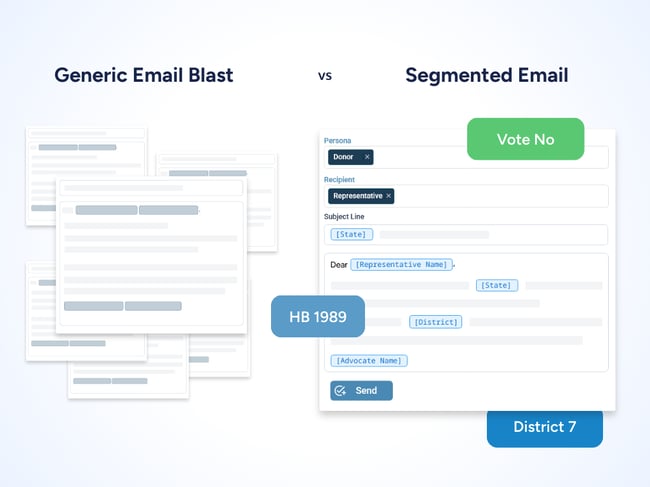
Targeted outreach increases conversion, improves responsiveness, and builds long-term commitment. That's the definition of strategy over busy work.
Do you measure the success of your program through list size or number of actions? Those metrics are sure to keep you busy and please funders - but there are more nuanced signs that your program is building influence and power that you just might not be measuring.
Research from the Congressional Management Foundation consistently shows that personalized communication carries greater weight with undecided lawmakers than mass form messages.
Strategic teams evaluate progress using a ladder of engagement that tracks supporter movement toward higher-effort actions - not just hitting the send button.
Henri Makembe shared a case study involving the LA Board of Supervisors in which supporters progressed from signing a petition to writing letters, making calls, and recording testimonial videos.
The decisive metric was the conversion rate between each step.
Depth of engagement predicts influence more reliably than raw participation numbers.
Campaign chaos often reflects a lack of strategic boundaries and goals you set with your team. Effective advocacy means protecting staff time, sharpening priorities, and aligning every tactic with a shared objective.
Focused issue selection, disciplined repetition, structured segmentation of participants, and focusing on key metrics can create sustained pressure that lawmakers recognize.
Organizations that operate with that discipline can move from being just busy... to busy building influence.
%20(3).png?width=1200&height=628&name=2026%20Grassroots%20Advocacy%20Effectiveness%20Benchmark%20Report%20(1200%20x%20628%20px)%20(3).png)